


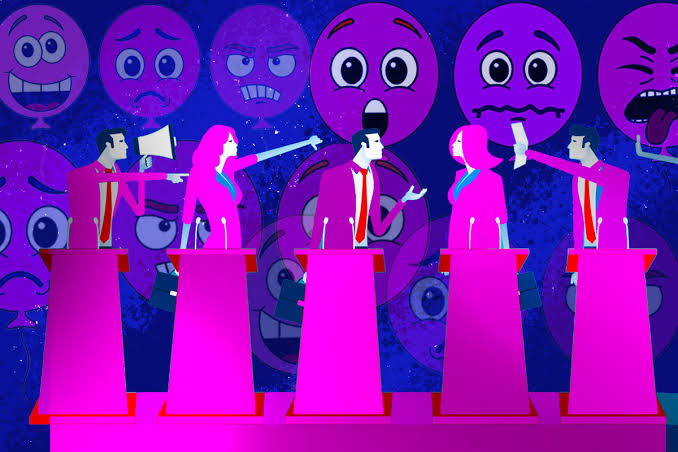
The role of emotions in political processes has long been undervalued. Indeed, until the ‘90s – 00s, political science assumed that electors were primarily rational actors, making purely rational decisions based on their interests and information at their disposal. However, this changed in recent decades, when an emotional culture, analysing emotions in all domains of human life, both private and public, began to emerge, valuing emotions as a structural component of political choices. Consequently, researchers have started to study the impact of emotional states in political life.
An example in this regard is the American political scientist George E. Marcus (2013), who, exposing his affective intelligence theory, criticises the Enlightenment model of the citizen as a political expert. For Marcus, this framework failed and needs to be rethought around emotive states and the new neuroscientific knowledge. In particular, the scholar distinguishes between two models of citizenship: deliberative citizenship, driven by anxiety and focused on the impartial and open pursuit of information, justice, and public good, and partisan citizenship, driven by enthusiasm and anger, loyal to a faction and oriented to victory. In this sense, anxiety strengthens openness and deliberation, while anger and enthusiasm strengthen existing habits and political identities. Certainly, this can be applied also to populism, linked by Marcus not to fear, as commonly believed, but to perceived threats toward traditions and identities. The political rise of Donald Trump has subsequently been discussed through this theoretical lens, particularly in relation to anger, political identity and mobilisation. Trump’s strategy focused not on fear but on anger, a stronger emotional state, and was more efficient in mobilising and consolidating electoral support, for the very reason it strengthens habits and identities already existent.
The influence of emotions in politics is clear by looking at the events that occurred in the last few decades: from the “Arab Spring” to the 2008 financial crisis and nationalist and xenophobic attitudes in Europe and in the USA, emotions have played a central role in shaping the political behavior of both the general public and policymakers. For this reason, emotional politics is increasingly becoming a central issue in the explanation of political processes, as Chantal Mouffe and Martha Nussbaum tried to explain in their theories focused on how emotions can be mobilised within liberal democracies.
Chantal Mouffe starts her explanation by referring to passions rather than emotions. Passions are, indeed, considered a better way to refer to collective identities given their collective nature, and the author’s goal is finding ways to mobilise them toward democratic designs. The theory of political agonism considers conflict as a founding element of democracy, a symbol of the inherent competition inside democratic regimes. However, according to the author, the key is making competition transition from antagonism, based on a struggle between actors who consider each other enemies, to agonism, in which opposing parties consider themselves legitimate actors in the political arena. Drawing on this theoretical framework, Mouffe distinguishes between two levels over which political reality flows: on one side there is the “political” side, referring to internal conflicts and tensions present in every society, and on the other side there’s “politics”, the institutional level which temporarily stabilises conflict through hegemony. At the same time, contemporary democracies combine two conflicting elements: the democratic component, based on popular sovereignty, equality, and boundaries, and the liberal component, emphasizing individual rights and universalism. The problem emerged after the end of the Cold War, when liberalism triumphed and resulted in a “consensus at the centre” which voided party competition and political identities, creating fertile ground for populist and extremist right-wing parties. Based on this reasoning, Mouffe considers it necessary to recognise the central role conflict has in democratic societies in generating different political identities. How to do it? In Mouffe’s account, populist politics can function as a way of constructing a collective “people” by articulating different social demands against an existing hegemonic order.
Martha Nussbaum, dealing with the issue of emotions in political processes, stresses on the fact that liberalism has failed for a long time to acknowledge the role of emotions in supporting an “aspiring yet imperfect society”, as she calls it. Her approach develops following two pillars: the social role of philosophy and a cognitive – evaluative consideration of emotions. Concerning the first one, philosophy should help individuals to pursue an “examined life”, helping them to reduce human pain. Starting from this theoretical perspective, Nussbaum develops her capabilities approach, which underlines the importance, among the fundamental capabilities, of the capability for emotions. This reflects the capability to love, to grieve, to experience gratitude, etc. The second pillar, on the other hand, draws from the Stoics’ conception of feelings not as corporal sensations but as evaluative judgements. According to Nussbaum’s theory, emotions are directed toward an object, intentionally perceived and interpreted according to one’s own beliefs and personal evaluation of its importance. This is what makes emotions different from “bodily appetites”, such as hunger or thirst, or “objectless moods”. Therefore, once the judgment is accepted, it becomes a stable part of one’s own cognitive structure, generating a durable emotion. In Nussbaum’s analysis of the 2016 US election, she connects Trump’s rise with the activation of what she describes as primal fear due to unfavourable socio-economic conditions. Even though they have an evolutionary history, emotions can be shaped by social contexts and norms. This is why there’s a need to build a society that favours hope and trust to reduce antisocial fear: practical hope built on narratives and institutions capable of mobilising social imagination and action.
“This article is edited by Mattia Turello, based on D2.2 Theories of Emotional Politics.”