

It’s the tone, not the disagreement: What wears out misinformation correctors, and why it matters for sustained citizen fact-checking
When a false claim spreads on social media, ordinary users are often the first to push back. And it works: research has shown that a single correction can reduce false beliefs, both for the person addressed and for everyone reading along (Bode & Vraga, 2021). But speaking up can come at a price, because those who correct others risk negative reactions in return (Gurgun et al., 2025; Vraga et al., 2015).
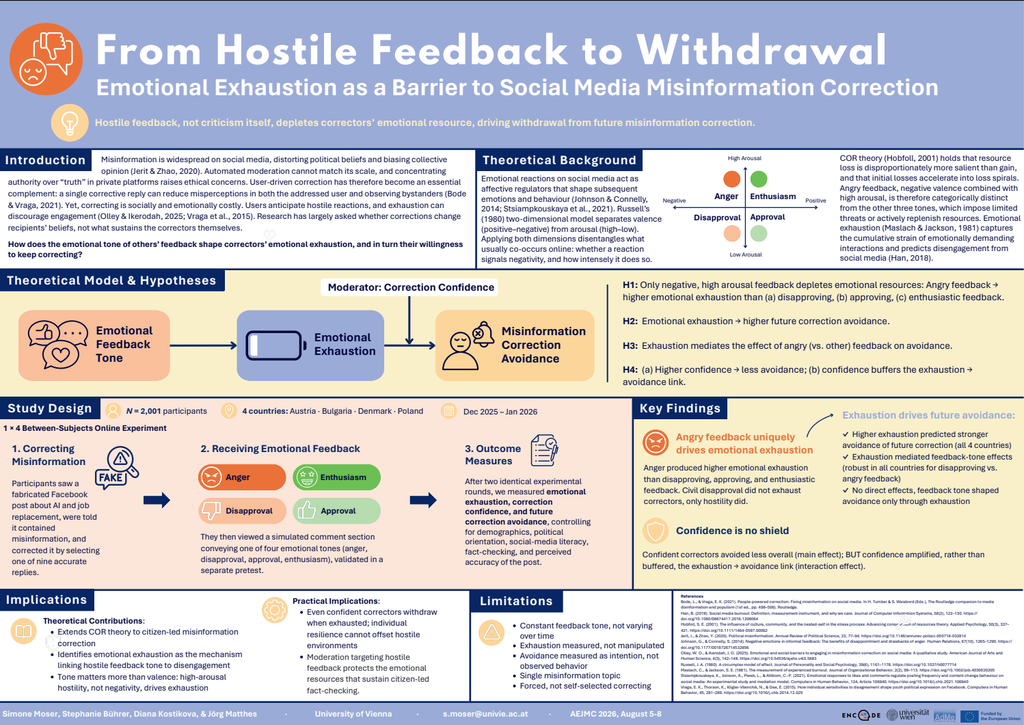
Our study (Moser et al., 2027) shows that not all negativity carries the same weight. Calm disagreement was no more draining for correctors than approving or enthusiastic replies. Angry, hostile replies, however, left them emotionally exhausted, and the more drained they felt, the less willing they were to step in the next time they came across misinformation.
What we did in our study
We ran an online experiment with 2,001 people in Austria, Bulgaria, Denmark, and Poland. Participants saw a made-up Facebook-style misinformation post claiming their government had secretly agreed to replace most routine jobs with AI by 2027. They were then asked to correct it, choosing from several fact-based replies. Next, they saw how other users supposedly reacted to their correction. Depending on the group the participants were randomly assigned to, the reactions were angry (e.g., “What you wrote is a LIE”), calmly disapproving (e.g., “I see it differently”), approving (e.g., “I think you’re correct”), or enthusiastic (e.g., “Thank you SO MUCH for calling this out!”). Participants then reported how drained they felt from those responses, how confident they were that their correction was accurate and effective, and whether they would correct misinformation again in the future.
What we found
Hostility drains, disagreement alone doesn’t. Angry replies left people more emotionally exhausted than both calm disagreement and positive replies. Polite disagreement, by contrast, was no more draining than approving or enthusiastic replies. This pattern was similar across all four countries.
Exhaustion predicts withdrawal. The more drained people felt, the less willing they were to correct misinformation in the future across every country studied.
Confidence is no buffer. People who felt confident about their correction were generally more willing to keep up with correcting misinformation. But in three of the four countries, this advantage faded once they felt drained by the reactions they received. In fact, the more confident they were, the more feeling exhausted held them back from correcting misinformation again.
Why this matters
Criticism itself is therefore not the problem. Disagreement is part of healthy debate, and calm pushback was no more draining for correctors than approving or enthusiastic replies. What does the damage is the hostile tone. And since feeling drained went hand in hand with less willingness to correct again, hostile replies may quietly reduce the number of people who challenge false claims online. For platforms and online communities, this points to moderating angry, abusive replies while leaving room for civil criticism. Encouraging people to speak up is not enough if the environment stays hostile. We conclude by arguing that a resilient democratic debate online depends on the emotional capacity of the people who defend it.
This article is edited by Simone Moser, based on the paper “From hostile feedback to withdrawal: Emotional exhaustion as a barrier to social media misinformation correction”.
References
Bode, L., & Vraga, E. K. (2021). People-powered correction: Fixing misinformation on social media. In H. Tumber & S. Waisbord (Eds.), The Routledge companion to media disinformation and populism (pp. 498–506). Routledge.
Gurgun, S., Arden-Close, E., Phalp, K., & Ali, R. (2025). User correction of misinformation on social media: Perceived and actual social norms. In J. Grabis, T. E. J. Vos, M. J. Escalona, & O. Pastor (Eds.), Research challenges in information science (pp. 331–346). Springer. https://doi.org/10.1007/978-3-031-92474-3_20
Moser, S., Bührer, S., Kostikova, D., & Matthes, J. (2027). From hostile feedback to withdrawal: Emotional exhaustion as a barrier to social media misinformation correction. Computers in Human Behavior, 187, Article 109179. https://doi.org/10.1016/j.chb.2026.109179
Vraga, E. K., Thorson, K., Kligler-Vilenchik, N., & Gee, E. (2015). How individual sensitivities to disagreement shape youth political expression on Facebook. Computers in Human Behavior, 45, 281–289. https://doi.org/10.1016/j.chb.2014.12.025