


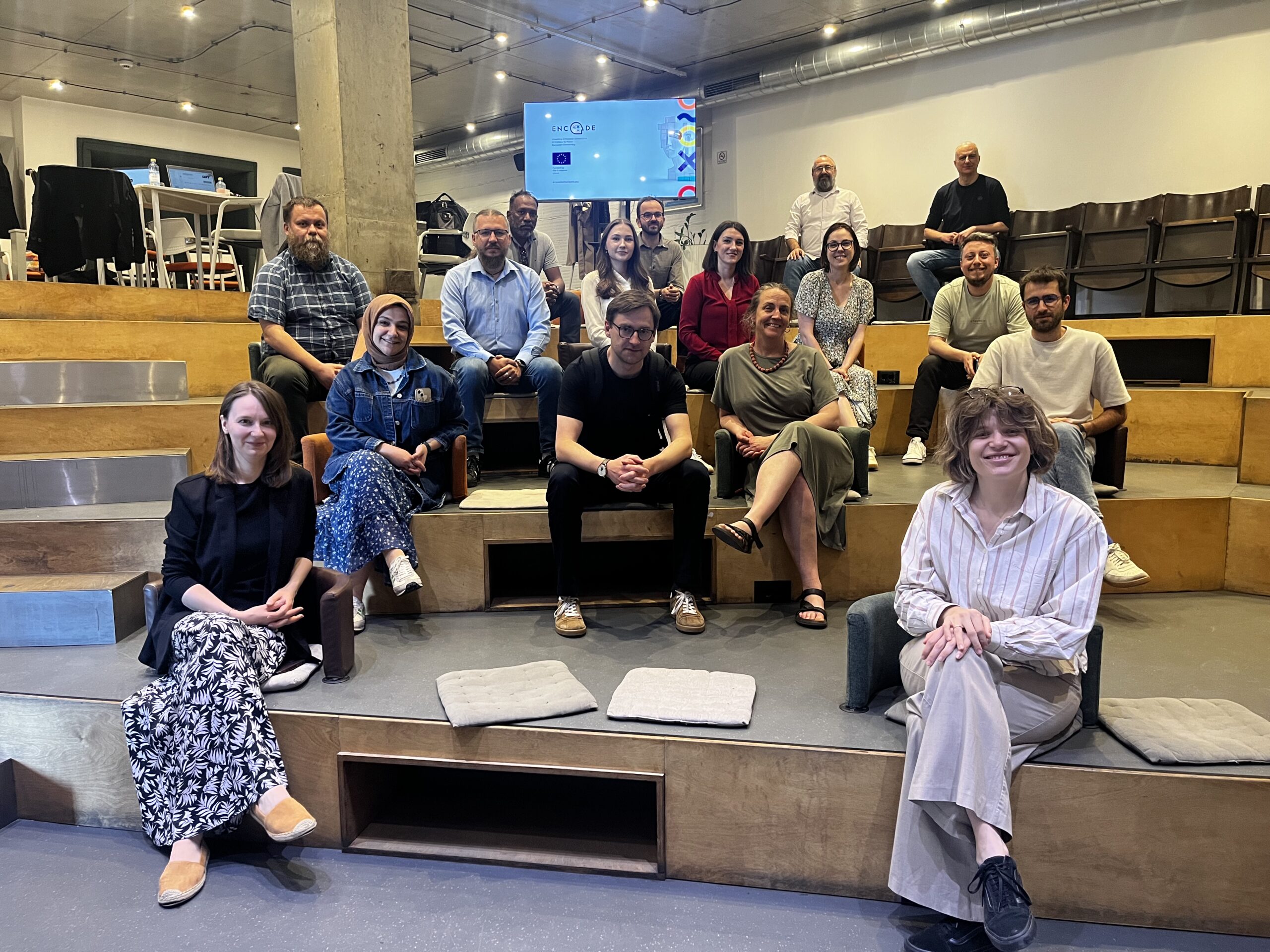
20–21 May 2026 | Skopje, North Macedonia
The ENCODE consortium came together in Skopje, North Macedonia, on 20–21 May 2026 for its General Assembly Meeting, hosted by the Institute for Democracy “Societas Civilis” – Skopje (IDSCS). Bringing together all project partners in person, the meeting provided an important opportunity to take stock of the work completed so far, exchange insights across research activities, and strengthen collaboration as ENCODE moves into its next phase.
Over two days, consortium members discussed the progress of the project and reflected on the research and activities carried out across the different strands of ENCODE. The meeting created space for partners to share updates, discuss emerging findings, coordinate upcoming activities, and explore opportunities for closer collaboration across the consortium.
Under WP4, partners reviewed the progress and emerging insights from the local experiments examining citizens’ emotional responses to political content through a combination of biometric and qualitative methods, including eye-tracking, facial expression analysis, surveys, and interviews. The discussion provided an opportunity to compare experiences across the different country contexts and reflect on how citizens respond emotionally to political communication. Partners also discussed the WP5 research findings, considering their implications for understanding emotional dynamics in political communication and democratic engagement. Building on these research insights, the consortium explored suggestions for WP6, particularly how emerging evidence could inform citizen co-creation activities and the development of more constructive, inclusive, and resilient future political narratives.
A central focus of ENCODE is understanding the role of emotions in political life and democratic engagement. The project brings together complementary perspectives and methods to examine how emotions interact with political communication, social media, citizen experiences, and democratic participation. The General Assembly therefore also offered an opportunity to connect insights from different areas of the project and consider how these contributions can inform the broader ENCODE research agenda.
Bringing ENCODE Research to the Public
Alongside the consortium meeting, IDSCS organised a public event in Skopje on 20 May, creating an opportunity to introduce ENCODE and its research to a wider audience beyond the project consortium.
The event brought together young people, researchers, representatives of civil society organisations, and other interested participants who engaged with the project’s research and ongoing work. Speakers from the ENCODE consortium presented key insights and discussed questions related to emotions, politics, political communication, social media, and democratic engagement.
The event provided an important space for dialogue between researchers and members of wider society. Rather than keeping research discussions within academic and institutional settings, the event opened the conversation to people who experience and participate in political and digital environments in their everyday lives.
The public event organised by IDSCS on 20 May provided an opportunity to bring ENCODE’s research to a wider audience in Skopje, bringing together young people, researchers, NGO and civil society representatives, and other interested participants. During the event, consortium members presented progress and emerging results from across the project, including the theoretical work and framework developed under WP2, findings from WP3’s analysis of social media communication and political narratives, insights from the WP4 local experiments exploring citizens’ emotional responses to political content, and research findings from WP5. The presentations highlighted how ENCODE combines theoretical perspectives with empirical and experimental research to examine the relationship between emotions, political communication, social media, and democratic engagement. Participants had the opportunity to follow the latest developments, ask questions, and exchange perspectives with researchers, creating a space for dialogue between the ENCODE consortium and wider society. The discussions also helped identify how emerging research insights can contribute to the next stage of the project, including the citizen co-creation and future narrative activities under WP6.
Participants had the opportunity to learn more about the progress of ENCODE, explore emerging research findings, and discuss why understanding emotions is important for making sense of contemporary political communication and democratic life. The exchange also highlighted the value of bringing different perspectives into conversations about the emotional dimensions of politics.
Strengthening Collaboration and Looking Ahead
The Skopje meeting demonstrated the value of bringing the ENCODE consortium together in person. With all partners present, the General Assembly strengthened communication across the project and provided a shared space to reflect on achievements, discuss challenges, and coordinate the work ahead.
The combination of the consortium meeting and the public event also reflected an important dimension of ENCODE: connecting research, collaboration, and wider societal engagement. By creating opportunities for researchers, civil society representatives, young people, and other members of the public to engage with the project, ENCODE continues to build dialogue around the role of emotions in political and democratic life.
The consortium now moves forward with the next phase of its work, building on the research, discussions, and collaborations developed throughout the project. The Skopje meeting marked another important step in this shared journey — bringing partners together, opening research to wider audiences, and strengthening the foundations for ENCODE’s continuing work on emotions and democracy.
The ENCODE consortium would like to thank IDSCS for hosting the General Assembly Meeting and for creating an important space for dialogue between the project and the wider public in Skopje.