

Political conversations online are not just about facts or opinions. They are rarely neutral and often deeply emotional. Enthusiasm, fear, anger, and hostility all shape how people talk about politics and how others respond.
To better understand this emotional landscape, the ENCODE project analysed political discussions on social media across Europe. The results show clear patterns in who expresses which emotions, how elections change the tone of debate, and why emotional content spreads more widely.
The research analysed political content shared on the social media platform X between 2022 and 2024 across six countries: Austria, Bosnia and Herzegovina, Bulgaria, Denmark, North Macedonia, and Poland. In total, more than 2.1 million posts and comments were studied. The analysis focused on three key voices in online politics:
- Politicians: entities (party leaders, prominent parliamentarians, and other figures of significant public visibility) which had secured more than 5% of the vote in the most recent national parliamentary elections.
- Media outlets: most influential and widely recognised media organisations within their respective national contexts. Including both mainstream (trustworthy) and non-mainstream (potentially untrustworthy or disinformation-prone) outlets.
- The general public: all social media users, age 18 and above, with public X accounts, not included in the politicians or media classifications.
It also compared everyday political discussion with periods around national and European elections.
How were emotions identified?
To make sense of such a large volume of content, the research combined human judgement with artificial intelligence. A sample of posts was first analysed by trained coders, who identified whether a post was political and which emotions and values it expressed. These annotations were then used to train multilingual AI models (Large Language Models, LLMs) capable of analysing political content across different languages and countries.
The study focused on five emotions: Fear and anxiety, happiness and enthusiasm, anger, hate, emotional neutrality; and six human values: Benevolence, security, universalism, tradition, self-direction, power.
Emotions and values often travel together
Political messages rarely express emotions in isolation. They are often linked to deeper value frames. Across millions of posts, the study found that emotions and values are usually connected. It must be noted that the links are not always strong, and very few of the connections explored turned out to be statistically significant. Nevertheless, some patterns appeared again and again:
- Messages expressing fear or anxiety are most often linked to security concerns.
- Happiness and enthusiasm tend to appear alongside benevolence and security.
- Anger and hate are connected to several values, but usually in weaker and more fragmented ways.
This shows that emotions help structure how political issues are framed and understood online.
Not everyone speaks the same emotional language
One of the clearest findings is that political emotions vary strongly depending on who is speaking.
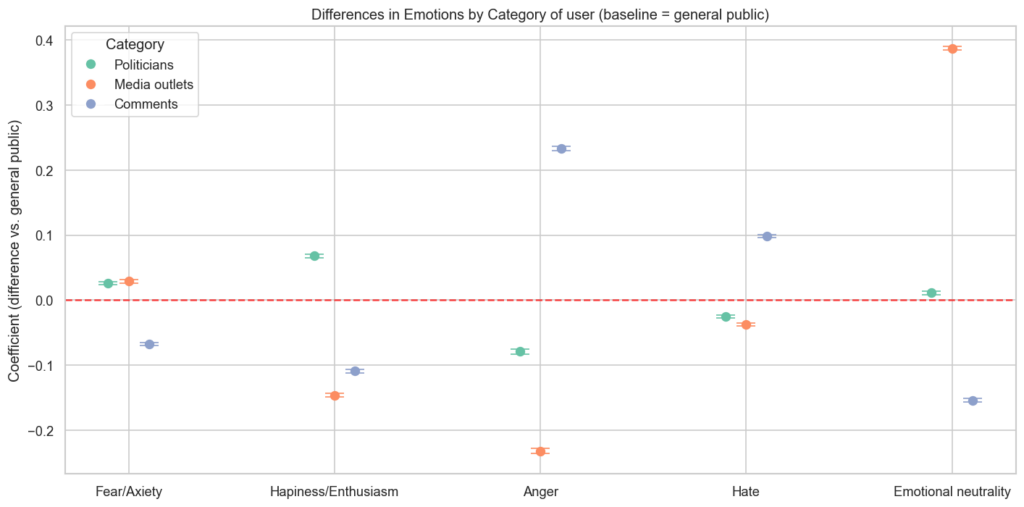
Politicians often mix optimism and concern, aiming at a careful emotional balance: motivating supporters while avoiding openly hostile language. When compared with the general public they tend to:
- Use more positive language (happiness and enthusiasm)
- Refer more often to fear and anxiety
- Avoid anger and hate
Media outlets tend to keep emotions in check, standing out for their emotional restraint. Their posts are much more likely to be emotionally neutral and much less likely to express strong positive or negative emotions. When emotions appear in news reporting, they are more often related to fear and risk, rather than enthusiasm or anger.
Comment sections under politicians’ posts are the places where conflict concentrates, resulting in the most emotionally intense spaces in social media, and transforming the debate into more confrontational tones. Comments usually contain:
- Much higher levels of anger and hate
- Much lower levels of enthusiasm, fear, and neutrality
What changes during elections?
Elections do change the emotional tone of online politics, but not in the same way everywhere.
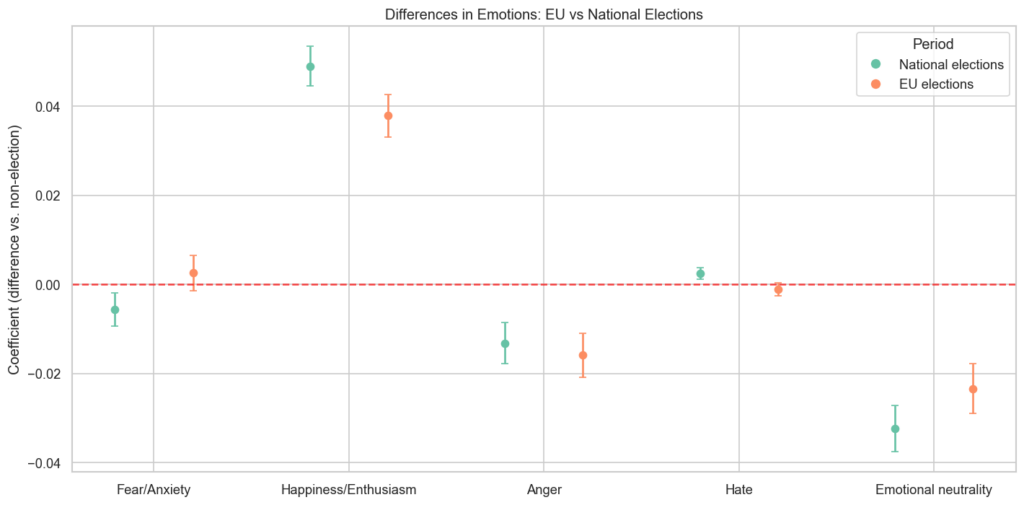
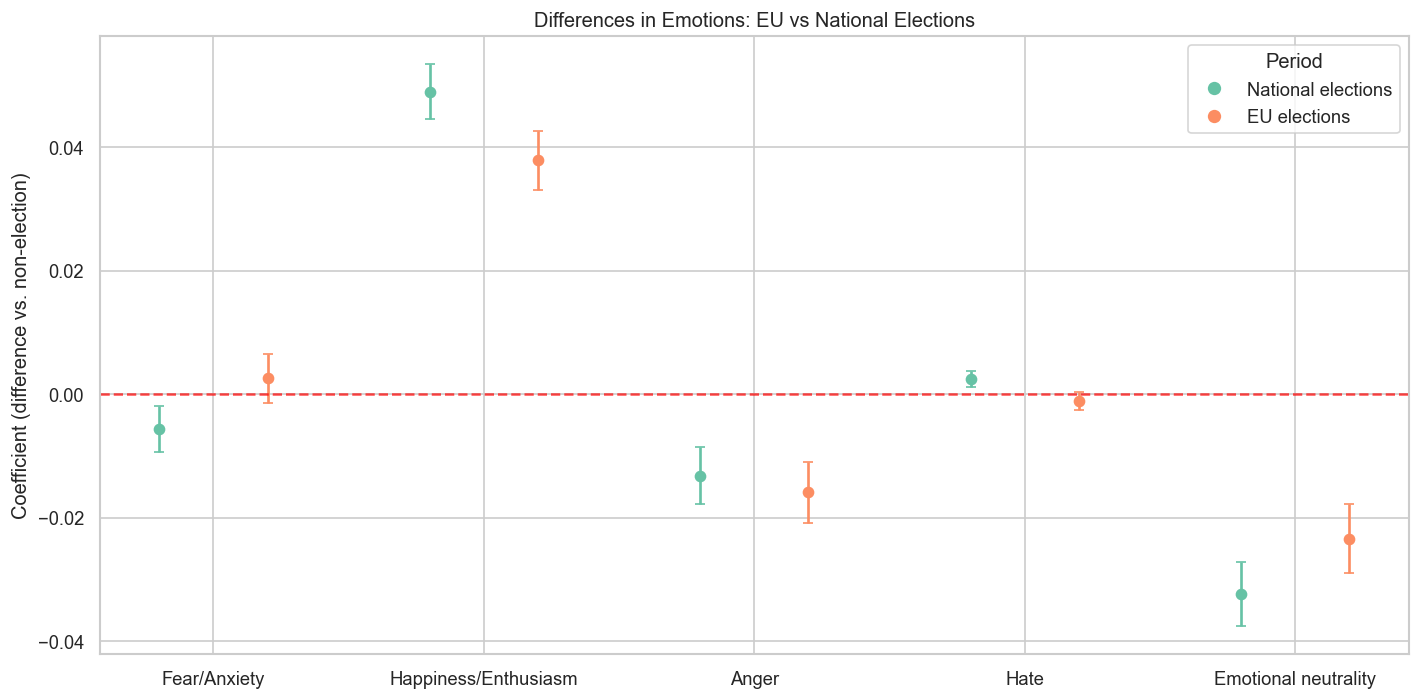
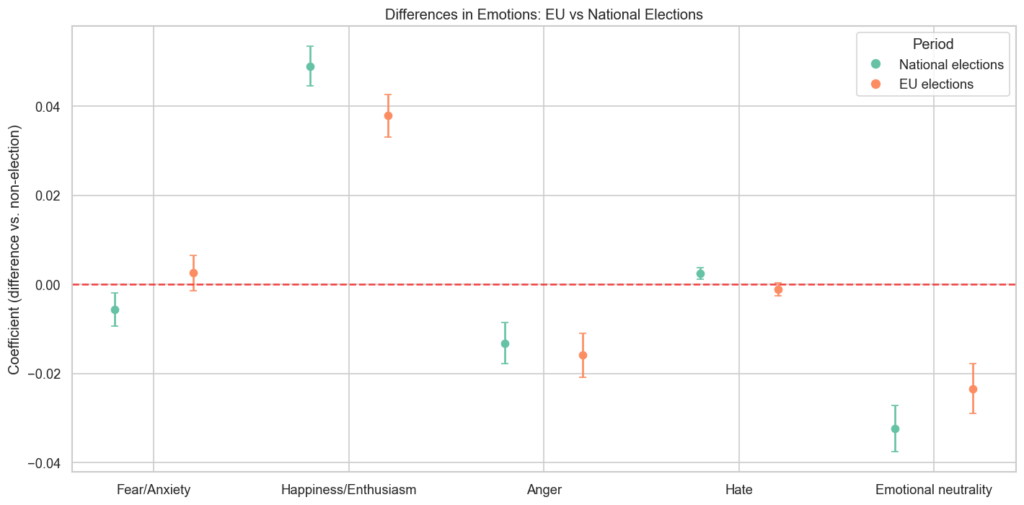
Public posts (from all the three key voices of focus of this study) display more enthusiasm and less neutrality, suggesting that election campaigns push public debate toward mobilisation and positivity, rather than open hostility. During election periods:
- Happiness and enthusiasm increase
- Neutral language decreases
- Anger becomes slightly less common
Comment sections instead display more anger but not more hate, suggesting that elections intensify disagreement and confrontation, without however resorting to the most extreme forms of hostility. During election periods:
- Anger increases
- Neutrality decreases
- Hate does not increase but actually declines slightly
Emotional posts get more attention
Emotions do not just shape political debate; they also shape visibility. The study shows that:
- Posts by politicians attract far more engagement than posts by other users.
- Happy and enthusiastic content consistently generates more likes, replies, and shares.
- Emotional media content spreads much more widely than neutral reporting.
Negative emotions matter too, but mainly when combined with political authority, especially when expressed by politicians.
Why does this matter?
These findings challenge the idea that there is one single “online public mood”. Instead, political emotions online are actor-specific, with politicians, media, and citizens behaving differently; context-dependent, as election periods change the rules; and platform-structured with comment sections and main pages serving different emotional roles.
Understanding these dynamics helps explain why some messages spread, why debates escalate, and why comment sections often feel so hostile.
For the ENCODE project, this evidence supports the development of better communication practices, strategies to counter disinformation, and emotion-aware democratic policies aimed at strengthening trust and resilience in European democracies.
Social Media Posts
Post 1
What happens emotionally in online political debate?
An analysis of 2.1 million posts across six European countries shows clear differences across countries and actors: politicians tend to rely on positive language and avoid anger, media outlets remain largely neutral, and comment sections are where anger and hate concentrate most strongly. There is no single “online mood”, and emotions depend on who is speaking, with observable differences between countries.
Read more here -> link to the article
#OnlinePolitics #PoliticalCommunication #ENCODEProject
Post 2
Did you know that elections change the tone of online political debate?
During election periods, public political posts become more enthusiastic and less neutral, while comment sections grow angrier without increasing hate. At the same time, emotional content, especially enthusiastic posts from politicians, consistently attracts more engagement and visibility.
Read more here -> link to the article
#Elections #DigitalDemocracy #ENCODEProject